
Define the grade before comparing suppliers
PH-XPNS 007 is offered in 20%, 40% and ≥98% specifications. The detailed HPLC, appearance, solubility and formulation information on this page applies to the ≥98% grade; qualify the 20% and 40% grades using their own documents.
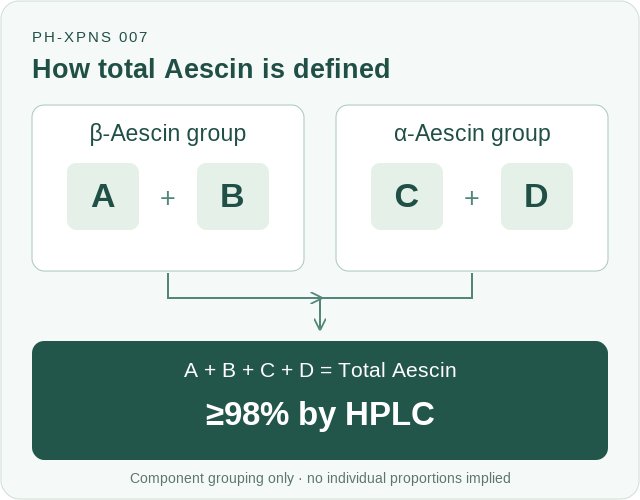
≥98% grade information: Begin a sourcing request with the commercial identity, intended application and acceptance criteria. For PINHONBIO® PH-XPNS 007, the product is Aescin / Escin, CAS 6805-41-0, with Total Aescin ≥98% by HPLC. Under our method, A+B form the β-Aescin group, C+D form the α-Aescin group, and all four components contribute to Total Aescin.
That definition is not a β-Aescin-only guarantee. If your purchasing brief calls for a separate β fraction, another form or a different botanical extract, resolve the identity before comparing prices. Ask how component names are assigned to analytical references rather than assuming that every supplier uses the same A/B/C/D lettering.
Confirm the contracting company and its role for the quoted material. Where your qualification program requires manufacturing-site evidence, request documents that relate to the product and facility involved. Broad company claims or unrelated factory photographs do not settle batch traceability.
UV, HPLC and titration: check what the number represents
Assay methods and reporting bases can differ. Keep the method and calculation basis attached to the selected specification; a matching percentage alone does not establish equivalent composition or quality.
| Method stated | Ask the supplier | Do not assume |
|---|---|---|
| UV spectrophotometry | Which measured total, reference material, sample preparation and calculation define the result? | That its percentage is interchangeable with a specific HPLC component sum |
| HPLC | Which peaks are identified and included, which standards are used, and how is the assay calculated? | That every HPLC percentage is a calibrated mass assay rather than peak-area reporting |
| Titration | Which method, reaction or endpoint, conversion basis and sample basis define the reported content? | That a 98% titration result automatically equals Total Aescin 98% by HPLC |
UV spectrophotometry and HPLC with a UV detector should not be treated as the same method label. PINHONBIO®'s supplied HPLC information includes detection at 220 nm; the word UV alone does not describe the chromatographic separation and component calculation.
Do not invent a conversion factor between methods. When comparable results are needed, agree the method and reporting basis first. The existing assay versus chromatographic purity guide explains why a chromatogram's peak-area total is not, on its own, proof of a product's mass assay.
Match the batch result to the release specification
≥98% grade information: A specification is the acceptance limit; a batch result is the outcome for identified material. For PH-XPNS 007, ≥98% by HPLC remains the supply specification. The reported 99.1% result describes one tested batch. It is not a promise that every future batch will be 99.1%.
Request the batch identifier, report date, method reference and relevant result for the material offered. If a supplier provides a representative COA during an early discussion, distinguish it from the actual shipment's release document. Likewise, do not link a chromatogram to a particular batch unless the records establish that connection.
The chromatogram displayed on the PINHONBIO® product page is supplied analytical material whose batch identity is not stated there. It is not presented as the 99.1% batch report. Ask for the appropriate batch-specific information when your qualification review requires it.
Give each document a specific job
- Product specification: establishes the identity, assay method, acceptance limits and agreed supplied form.
- Batch COA: connects the offered lot to its reported test results.
- TDS: describes the grade's technical properties and supported handling information.
- SDS: supports handling and safety review for the supplied composition; request the applicable document and confirm availability.
- Analytical supporting information: helps your team assess component assignments, calculations and method suitability.
- Qualification documents: address the manufacturer, site or destination-market requirements actually relevant to your purchasing program.
Check that the product name, code, grade and applicable batch details agree across these records. The phrase cosmetic grade Aescin does not replace the documentation your destination market and quality process require. Do not assume that a certificate available for another ingredient covers this product.
Test the properties that an assay cannot settle
≥98% grade information: Use an actual sample to assess the intended appearance and incorporation route. PH-XPNS 007 is an off-white to white powder with reported water solubility ≥20 g/100 mL water at 25°C, forming a clear solution. PINHONBIO® also reports dissolution within a few minutes in its evaluation; your own test should record the preparation conditions and elapsed time.
That water result does not establish complete-formula stability, a maximum cosmetic dose or finished-product performance. For aqueous serums, gels and eye-area formulation projects, assess the actual base and packaging against the project's requirements. The water-soluble Aescin formulation guide provides a staged evaluation checklist.
If repeatability across supply is important, request the relevant batch-control information or multiple-batch evidence. One acceptable sample supports a sample decision; it should not be described as a statistical demonstration of long-term batch consistency.
Turn a quotation into a comparable supply offer
Ask each candidate to quote the same defined grade and quantity. Confirm the sample policy and sample amount separately from the trial-order quantity, commercial MOQ and packaging. A package size is not necessarily an MOQ, and a sample offer is not evidence of stock for a larger order.
Record destination, required documents, pack configuration and expected timing. Distinguish preparation or production time from transport after dispatch. Confirm larger quantities and recurring requirements directly; this guide does not assign an unverified stock level, manufacturing lead time or delivery guarantee to PH-XPNS 007.
Before ordering, resolve mismatches between the quote, specification and sample. If the underlying choice is still between a high-purity ingredient and a botanical extract, use the Aescin versus Horse Chestnut Extract comparison to settle the material brief first.
Send PINHONBIO® a request that can be evaluated
PINHONBIO® manufactures and supplies Aescin / Escin PH-XPNS 007 with a defined total-Aescin specification and published water-test conditions. Start with the product specification and downloadable TDS.
Include the product code, quantity, destination market, intended cosmetic system and required batch documents in your request. Ask for the sample or analytical information needed to close your qualification gaps, then confirm the commercial offer in writing. This gives the formulation, quality and purchasing teams the same material definition to work from.
Frequently asked questions
Is HPLC or a four-peak total unique to one supplier?
No. Public suppliers also describe HPLC grades and four-peak totals. Compare the exact grade, component assignments, calculation and accompanying physical data rather than treating the method label as exclusive.
Can I compare UV 20% and HPLC 20% directly?
Do not assume equivalence from the labels. Review the measured components, standards, preparation and calculation basis, and agree a common method if a directly comparable result is required.
Does the 99.1% batch change PINHONBIO®'s ≥98% specification?
No. The batch result and the minimum supply specification serve different purposes. Qualify the offered lot against the agreed ≥98% HPLC specification.
Are samples, MOQ and delivery times fixed by this guide?
No. Confirm those commercial details for the quantity and destination in the actual quotation.
What should an initial inquiry include?
PH-XPNS 007, Total Aescin ≥98% by HPLC, intended application, requested quantity, destination and the documents or analytical information your team needs.
Your next decision
An effective Aescin supplier review connects the quoted grade, method, batch evidence, sample behavior and supply terms. Resolve those connections before treating two percentages—or two supplier offers—as equivalent.