
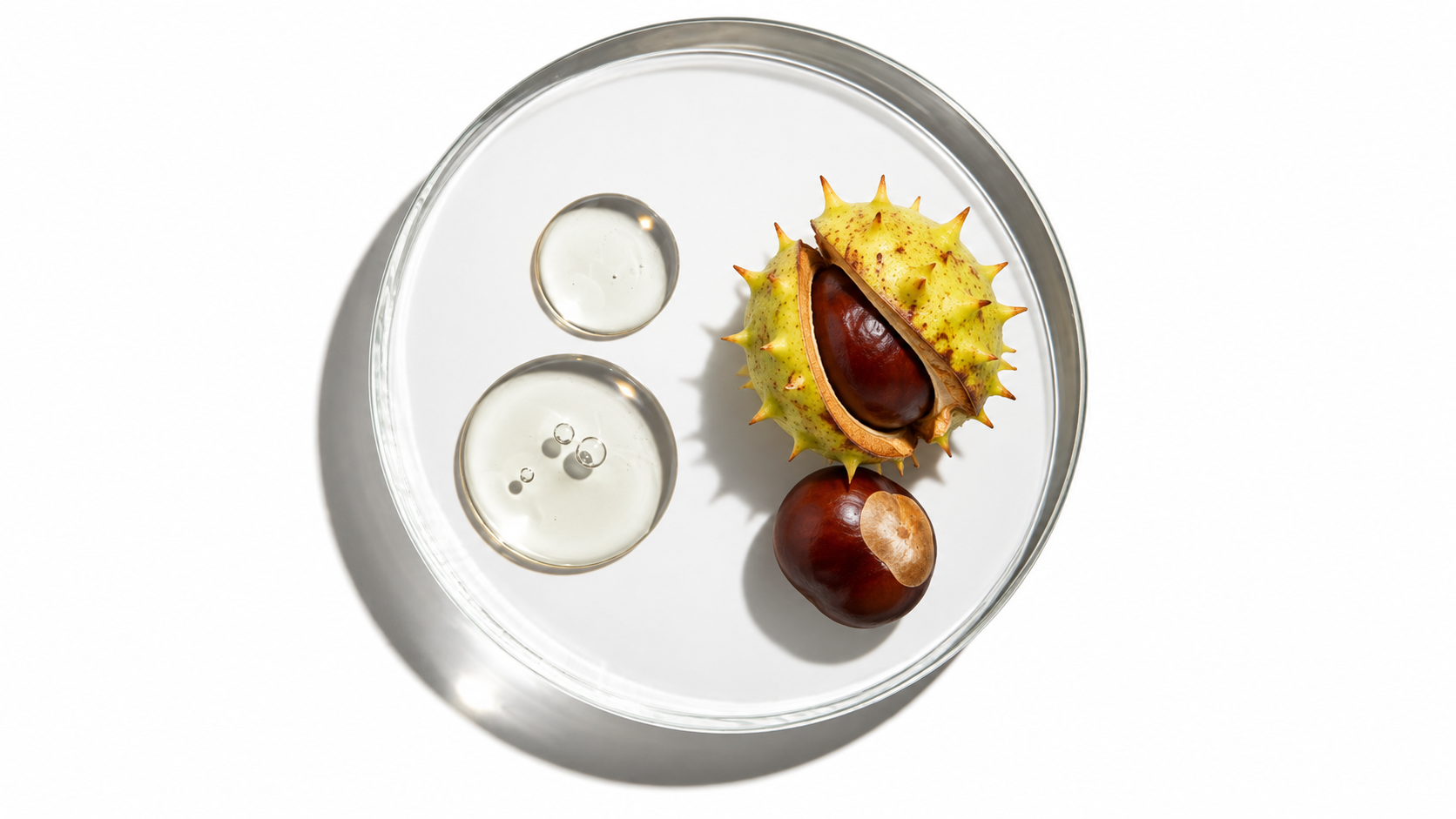
The two names answer different questions
Horse Chestnut Extract tells the buyer about a botanical material. Its useful technical identity also includes the botanical species, plant part, extraction or supplied form, standardization and any declared carriers or other ingredients. It does not, by itself, tell you how much Aescin is present.
Aescin is a mixture of saponins rather than a claim that a material contains only one molecule. Research has quantified several related escins and isoescins in horse chestnut seeds. The terminology should be read with the composition and analytical method. See the HPLC analysis of four major saponins.
A high-purity total-Aescin ingredient may suit a project seeking a defined assay and a specific physical profile. A standardized botanical extract may fit a brief built around that extract's documented composition. Neither category is automatically the correct choice for every cosmetic product.
Compare the supplied materials on the same terms
| Buyer question | Horse Chestnut Extract | PINHONBIO® PH-XPNS 007 |
|---|---|---|
| What is the identity? | Confirm species, plant part and supplied composition | Aescin / Escin from Aesculus chinensis seeds; CAS 6805-41-0 |
| What does the assay cover? | Check the named analyte or total and its calculation basis | Total Aescin ≥98% by HPLC |
| How are components grouped? | Read the supplier's method and reference assignments | A+B = β group; C+D = α group under our method |
| What appearance should be expected? | Use the grade specification and actual sample | Off-white to white powder |
| What water result is documented? | Request grade-specific concentration, temperature and appearance | ≥20 g/100 mL water at 25°C, forming a clear solution |
| Can it replace another material? | Only after the specification, intended role and finished-formula evaluation support the change | |
The extract column is a checklist, not a claim that every conventional extract has the same color, low assay or poor solubility. A high percentage alone also does not establish a superior contaminant profile or greater cosmetic efficacy.
Read the method beside the percentage
Public supplier information illustrates why a percentage needs context. An AMULYN page includes a representative COA with a ≥20% Aescin specification, a 21.2% result and UV as the method. Aktin lists a 20% grade measured by HPLC with four peaks combined, and a 98% grade measured by titration. These are the suppliers' published declarations, not independent verification of their materials. AMULYN product and COA; Aktin specifications (reviewed 11 September 2026).
Do not convert UV, HPLC and titration percentages using an assumed fixed factor. Ask what is measured, which reference material is used and whether the result is calculated on the supplied material or another reporting basis. A supplier listing more than one method may be offering different grades; it does not necessarily mean one batch carries identical results under every method.
For the procurement checks behind this comparison, read the Aescin supplier guide. For the broader distinction between a calibrated assay and peak-area reporting, see HPLC assay versus chromatographic purity.
Total Aescin is not a β-Aescin-only specification
Under PINHONBIO®'s analytical method, β-Aescin is represented by A+B and α-Aescin by C+D. Total Aescin is calculated from A+B+C+D. Our ≥98% HPLC specification therefore applies to the combined total. It does not establish ≥98% β-Aescin or a fixed ratio between the two groups.
Keep the commercial product name, CAS number and component definition together when comparing quotations. PH-XPNS 007 is Aescin / Escin, CAS 6805-41-0. Method-specific component identifiers should not silently replace that commercial product identity. A separate β-Aescin grade needs its own specification and evidence.
Choose for the appearance and composition your project needs
If your brief emphasizes a defined total-Aescin assay, pale powder appearance and water compatibility, PH-XPNS 007 is a grade to evaluate. Its reported water result makes it relevant to aqueous serums, gels and other water-based cosmetic development.
If your existing formula is built around a particular Horse Chestnut Extract, start by reviewing why that extract was selected. A substitution should account for the declared composition and the contribution of the entire supplied material. Matching one assay figure does not reproduce every property of the original extract.
For either route, compare samples against your own appearance and quality criteria. Do not assume that changing to a higher assay permits a proportional dose reduction while preserving efficacy, skin tolerance or stability. Those are separate formulation and finished-product questions.
Check these points before approving a substitution
- Identity mismatch: botanical source, product name, grade and declared composition must refer to the same material.
- Method mismatch: equal label percentages can represent different analytical definitions.
- Appearance mismatch: compare the actual material in your base, including color, clarity and odor where relevant.
- Process mismatch: document how the sample was incorporated and confirm the result in the intended production process.
- Evidence mismatch: a test on one grade or one batch should not be represented as evidence for a different supply.
The water-soluble Aescin formulation guide explains how to move from the water test to a complete-formula evaluation without turning initial clarity into a stability claim.
Where PINHONBIO® fits the comparison
PINHONBIO® manufactures and supplies Aescin / Escin PH-XPNS 007 for cosmetic ingredient evaluation. The commercial specification is Total Aescin ≥98% by HPLC. One reported tested batch returned 99.1%; that result does not replace the minimum supply specification.
Review the public TDS, the method-specific composition explanation and the supplied powder and solution photographs. Then request the batch information and sample needed to assess your own formula. Packaging, quantities, timing and document requirements should be confirmed in the quotation rather than inferred from a general product description.
Frequently asked questions
Is Aescin another name for every Horse Chestnut Extract?
No. Horse Chestnut Extract describes a botanical material. Aescin / Escin describes a saponin mixture that may be used to standardize an extract or supplied as a high-purity ingredient. The commercial specifications still need to be compared.
Does a 98% label always mean HPLC?
No. Public supplier specifications include 98% grades described using titration, and other pages list HPLC or multiple methods. Ask for the method tied to the exact grade and batch.
Is high-purity Aescin always the better choice?
No. It can fit a brief requiring a defined assay and physical profile, but the correct choice depends on the full material specification, formulation role and evaluation results.
Does PINHONBIO®'s ≥98% specification refer only to β-Aescin?
No. It refers to Total Aescin, calculated as A+B+C+D under our analytical method.
Can a clear water result be assumed for another supplier's extract?
No. Request that material's documented water-test conditions and evaluate its actual sample.
Your next decision
Compare the identity, method and formulation behavior before choosing between a botanical extract and a high-purity total-Aescin ingredient. A useful comparison makes the material and its evidence clear enough to support a sample decision, rather than treating the highest percentage as the answer.